Cryogenic storage is unforgiving: the “shell” is not just a container—it’s your primary thermal barrier, safety boundary, and long-term operating cost driver. If you store products like LNG, liquid oxygen (LOX), or liquid nitrogen (LIN), the tank architecture directly controls boil-off, compliance risk, and lifecycle ROI.
For low-risk or less volatile applications, a single wall tank can be acceptable. But for most industrial gas and LNG projects—especially where safety codes, secondary containment, and evaporative losses matter—the double wall cryogenic storage tank has become the engineering default.
Why Cryogenic Tank Architecture Matters (Beyond “Cold Storage”)
Cryogenic liquids are stored at extremely low temperatures to remain in liquid form (e.g., LNG near -162°C). Any heat leak through the tank wall drives:
Thermal losses → higher operating costs
Boil-Off Gas (BOG) → venting, recondensing, or utilization requirements
Safety and compliance exposure → especially for flammable (LNG) or oxidizing (LOX) fluids
The real question for project managers and engineers isn’t “can we store it?”—it’s how stable, safe, and compliant will it be over 20–30+ years.
What Is a Single Wall Cryogenic Tank? (The Baseline)
A single wall cryogenic tank typically refers to a single containment vessel with insulation applied externally (or integrated in limited ways), commonly used where the product risk profile and containment regulations are less stringent.
Where single wall tanks can make sense
Lower-hazard cryogens or certain industrial liquids under controlled conditions
Small-scale, low-footprint installations with simplified permitting
Projects where CAPEX is the dominant constraint and OPEX risk is accepted
The tradeoffs engineers see in practice
Pros
Cons
Higher heat ingress risk → more product loss and operational complexity
Greater chance of “sweating,” ice buildup, or condensation-related corrosion
Increasingly challenged by secondary containment expectations and modern safety regimes
In many regions and industries, single wall solutions are becoming harder to justify when fire codes, environmental expectations, or owner risk tolerance demand robust containment.
Deep Dive: Engineering a Double Wall Cryogenic Storage Tank
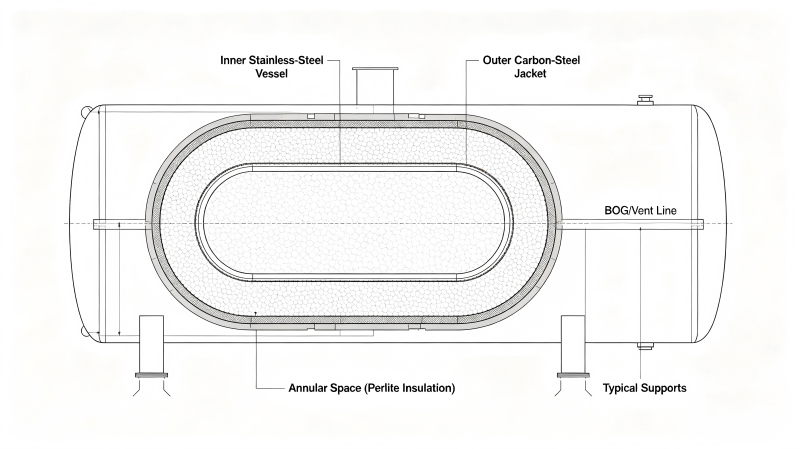
A double wall cryogenic storage tank is a “tank-in-tank” system designed to drastically reduce heat leak and provide integrated containment.
1) The “tank-in-tank” concept: inner vessel vs. outer jacket
Inner vessel (primary containment)
Typically made from austenitic stainless steel (or other cryogenic-rated alloys) for low-temperature toughness and ductility
Designed for product compatibility, pressure/temperature loading, and fatigue cycles
Outer jacket (secondary shell / structural protection)
Commonly carbon steel, providing structural durability and environmental shielding
Functions as a protective enclosure and (depending on design code) part of the containment philosophy
2) The annular space: where thermal performance is won or lost
Between the inner vessel and outer jacket is the annular space—engineered to minimize conduction, convection, and radiation. Common insulation strategies include:
Perlite insulation (widely used for large tanks and proven long-term stability)
Vacuum-jacketed designs (often for smaller vessels where very low heat leak is critical)
Multi-layer insulation (MLI) in specialized high-performance configurations
Lower heat ingress directly translates into reduced BOG generation, less venting/reliquefaction demand, and more predictable operations.
Fortune Gas design range (project flexibility)
Fortune Gas applies double wall cryogenic engineering across a wide span of capacities—from small vessels (around 1 m³) to large industrial storage (up to ~50,000 m³)—supporting LNG and industrial gas use cases with scalable design choices (materials, insulation method, pressure class, and site constraints).
Single Wall vs. Double Wall: Head-to-Head Comparison
| Engineering Factor | Single Wall Cryogenic Tank | Double Wall Cryogenic Storage Tank |
|---|
| Thermal efficiency | Higher heat leak; higher evaporation risk | Lower heat leak; reduced BOG and more stable holding time |
| BOG management | Often requires more frequent venting/handling | Easier to design around predictable, lower BOG rates |
| Safety | Limited inherent redundancy | Built-in secondary containment concept (critical for LNG/LOX risk profiles) |
| Durability | External exposure can accelerate corrosion/icing issues | Outer jacket shields inner vessel from environment |
| Compliance readiness | May face permitting hurdles in stricter jurisdictions | More aligned with modern containment expectations |
| Standards alignment | Depends heavily on design and application | Commonly engineered to recognized frameworks (e.g., API 620 for large tanks, ASME Section VIII for pressure vessels) |
| Lifecycle cost (ROI) | Lower CAPEX; potentially higher OPEX | Higher CAPEX; typically stronger long-term ROI via efficiency and risk reduction |
Expert Tip: When selecting a double wall cryogenic storage tank for LNG, confirm the outer shell and overall system are engineered for credible upset scenarios—such as thermal shock and “cryogenic splash”—so secondary containment remains reliable under abnormal conditions.
When Should You Choose a Double Wall Design?
1) Large-scale storage (especially flat-bottom tanks)
If your project involves bulk storage and long holding time expectations, double wall architectures are often the practical path for performance and compliance—particularly with flat-bottom storage tanks.
See Fortune Gas solutions here: flat-bottom storage tanks
2) Hazardous or high-purity fluids
For LNG and high-consequence industrial gases (LIN, LAR, LOX), the double wall approach better supports:
3) Urban or strictly regulated environments
Where local codes mandate secondary containment or impose strict risk controls near people, critical infrastructure, or property lines, double wall designs reduce permitting friction and improve insurability.
The Fortune Gas Advantage: Precision Engineering for Industrial Outcomes
Selecting a tank is not just selecting capacity—it’s selecting evaporation behavior, inspection philosophy, fabrication quality, and code alignment.
Customization that affects real-world performance
Fortune Gas can tailor designs around:
Operating pressure and allowable evaporation rate targets
Site ambient conditions (wind, humidity, marine exposure)
Fill/withdrawal patterns that drive thermal cycling and BOG peaks
Quality systems that reduce project risk
For cryogenic service, fabrication quality is not optional. Look for:
Verified material traceability and cryogenic-rated metallurgy
Rigorous NDT (Non-Destructive Testing) planning (e.g., weld inspection regimes aligned to code and project spec)
Document control that supports commissioning, audits, and long-term maintenance
Proven capability at large scale
For owners planning major LNG or industrial gas infrastructure, Fortune Gas also demonstrates capability for 20,000 m³+ class projects, supporting execution confidence across design, manufacturing, and delivery.
To strengthen topical authority across your gas project ecosystem, also review Fortune Gas’s related systems such as Air Separation Units (ASU), which often interface with LIN/LOX storage and distribution planning.
Conclusion: Choose the Architecture That Protects Your Product—and Your Project
Single wall cryogenic tanks can still serve niche, lower-risk scenarios. But for modern LNG and industrial gas projects, the double wall cryogenic storage tank is typically the superior investment: better thermal performance, stronger safety posture, and better alignment with long-term compliance and operating cost control.
Next step: Consult with the Fortune Gas engineering team to determine the optimal tank configuration for your site.
FAQs
What is the purpose of a double wall tank?
A double wall tank provides a primary inner containment vessel plus a secondary outer shell, improving thermal insulation performance and adding an additional layer of containment protection—especially important for LNG and other high-consequence cryogens.
How long do cryogenic storage tanks last?
With correct design, fabrication quality, inspections, and maintenance, cryogenic storage tanks commonly achieve 20–30+ years of service life. Actual lifespan depends on duty cycle, environment, and maintenance standards.
Why is perlite used in cryogenic tanks?
Perlite insulation is widely used because it’s thermally effective, stable over time, and well-suited to annular-space insulation in large cryogenic tanks—helping reduce heat leak and BOG generation.

