In industrial gas production, selecting the appropriate air separation technology is crucial for efficiency, cost-effectiveness, and meeting operational goals. While non-cryogenic systems like PSA (Pressure Swing Adsorption) and VPSA (Vacuum Pressure Swing Adsorption) can address small-to-medium scale needs, Cryogenic Air Separation Units (ASUs) remain the gold standard for high-purity, large-volume, and multi-product systems. This article benchmarks these technologies, explains the "why" behind their differences, and provides guidance for making the right decision based on 2026 market demands.
Decoding the Technology: Physics Behind the Performance
Understanding the physics behind air separation technology is the starting point to see why cryogenic systems dominate certain market segments.
Cryogenic Distillation: Pure Precision through Low Temperatures
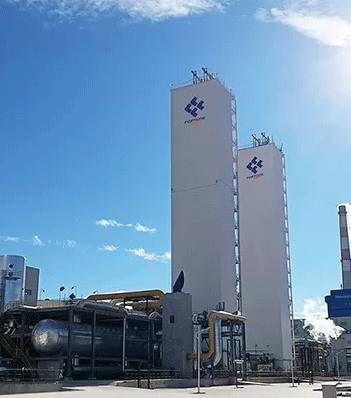
Cryogenic ASUs leverage the principle of fractional distillation at ultra-low temperatures, exploiting the boiling point differences of atmospheric gases like nitrogen, oxygen, and argon. Ambient air is compressed, cooled to cryogenic temperatures (below -185°C), and processed to separate pure gases in liquid or gaseous forms. The result? Purities of up to 99.999% for oxygen and nitrogen, coupled with argon recovery for added ROI.
Advantages:
Suitable for high-volume production.
Unmatched purity and the ability to extract noble gases like argon.
Ideal for industries with liquid storage or peak shaving needs.
Non-Cryogenic Technologies: Adsorption and Membrane Methods
Non-cryogenic systems like PSA and VPSA operate on molecular sieves, such as zeolite, which selectively adsorb gases like nitrogen under pressure to yield oxygen or vice versa. Membrane systems rely on selective permeability to separate gases.
Advantages:
Challenges:
Fortune-Gas Insight: Our advanced ASU units utilize proprietary heat exchanger technology, minimizing startup times and ensuring stability in multi-gas production.
2026 Benchmarking Criteria: Which Technology Wins?
To support buyers in making informed choices, we benchmark cryogenic and non-cryogenic systems based on the operational needs of 2026 industries.
| Criterion | Cryogenic (ASU) | Non-Cryogenic (PSA/VPSA) |
| Product Purity | Up to 99.999% (O2, N2) and Argon recovery | Typically 93-95% (O2), up to 99.9% (N2). No Argon recovery. |
| Production Scale | Best suited for >200 TPD applications | Cost-effective for <200 TPD projects. |
| Energy Intensity | ~0.5-0.6 kWh/Nm³ (Premium ASUs) | ~0.2-0.3 kWh/Nm³ (O2) |
| Startup Time | ~12-24 hours | ~30 minutes |
The "Tipping Point" in Scale Efficiency
Cryogenic air separation becomes more cost-effective when gas demand exceeds 200-300 Tons-Per-Day (TPD) or when high-purity gases like argon and 99.999% nitrogen are required.
The Rise of Modular "Plug-and-Play" ASUs
Historically, cryogenic plants demanded significant on-site construction and commissioning efforts, extending project timelines and costs. However, modular skid-mounted ASUs from Fortune-Gas now offer a "plug-and-play" approach for streamlined deployment, even in remote locations.
Digital Twins: Next-Gen Monitoring
Incorporating Digital Twin technology, our ASUs allow plant operators real-time monitoring of system health, optimizing performance while minimizing downtime. This innovation is especially beneficial for critical applications, such as mining projects or energy facilities, where reliability is non-negotiable.
Feature Highlight: Skid-mounted ASUs designed by Fortune-Gas can be operational within weeks, significantly reducing time to market.
Strategic Decision Factors for Plant Managers
Making the right purchase decision depends on several application-specific variables. Here are critical aspects to consider:
The Argon Advantage
If your facility requires substantial argon production or ultra-pure gases, non-cryogenic technologies aren't an option. Cryogenic ASUs remain the only choice for noble gas recovery.
Liquid vs. Gaseous Demand
Plant managers in industries with fluctuating gas consumption often rely on cryogenic systems for their ability to produce both gaseous and liquid products, ensuring stable supply even in peak demand scenarios or emergencies.
Key Takeaway: Fortune-Gas ASUs offer both on-demand gas production and liquid storage solutions tailored to industrial requirements.
Environmental & Economic Impact: The 2026 "Green" Focus
As the global push toward energy transition and decarbonization intensifies, air separation plays a pivotal role in supporting greener industrial practices.
Decarbonization with ASUs
High-efficiency cryogenic units, like those from Fortune-Gas, are integral to the Green Hydrogen Economy—providing oxygen for gasification processes and minimizing energy use with cutting-edge heat exchanger designs.
Reducing Carbon Footprints
Fortune-Gas ASUs optimize energy usage with advanced thermodynamic designs, reducing the specific power consumption (SPC) to industry-leading levels. In energy-intensive sectors, these developments significantly lower operating carbon emissions.
FAQ: What is the Typical ROI for Cryogenic ASUs vs. PSA Systems?
Cryogenic ASUs have a higher upfront cost but provide consistent savings with low SPC (kWh/Nm³) and the ability to monetize secondary products like argon and liquid oxygen. Typically, payback periods range from 3-5 years, depending on the scale and gas mix required. PSA systems, while cheaper to install, offer less value for large-scale and high-purity operations.
Conclusion: Engineering Your Gas Independence
For industries prioritizing high-purity gases, multi-product capabilities, and long-term scalability, cryogenic air separation remains unrivaled. With innovations like modular designs and energy-efficient systems, Fortune-Gas ASU technology positions your operation for sustainability and success in 2026 and beyond.

