In petrochemicals, metallurgy, and large-scale chemicals, “time to first gas” is often the KPI that decides whether a project stays on schedule—or becomes a cost spiral. Yet traditional air separation unit (ASU) builds are notorious for long site durations, weather disruption, high-altitude welding risk, and labor availability constraints.
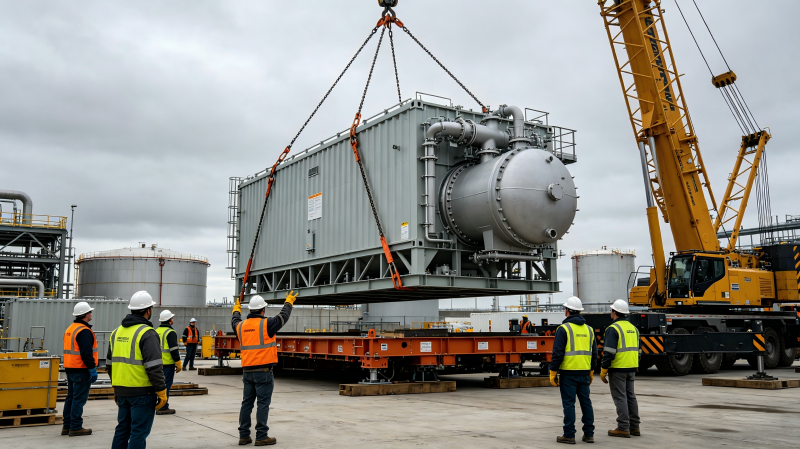
That’s why the modular air separation unit has moved from “nice-to-have” innovation to a practical execution strategy. By shifting complex work into controlled factory environments, modularization reduces uncertainty and compresses schedules. Fortune Gas highlights this shift through its large-scale modular air separation cold box delivery for Rongsheng Petrochemical’s GOX50,000 ASU project supporting the Zhoushan Jintang New Materials Project (reported as a 70 billion yuan investment in Fortune Gas’ release).
Beyond Portability: The Rise of Large-Scale Modular Integration
Modularization used to mean small skids and “package units.” What’s different now is large-scale modular integration—where historically site-assembled equipment is engineered to ship as fewer, larger modules, without compromising cryogenic performance, alignment tolerance, or safety.
Skid-Mounted ASU Technology for Mega-Equipment
A core enabler is skid-mounted ASU technology (monolithic, transport-ready structural frames) that allows major assemblies to be fabricated, fitted, and partially integrated offsite—then installed rapidly.
Fortune Gas’ referenced project centers on a large-scale modular cold box designed for air separation service. In its own announcement, Fortune frames this as “world-leading” modularization intended to reduce site workload and accelerate execution for the Zhoushan Jintang project.
Why this matters in cryogenic engineering: cold boxes package insulation, piping, and internals in a controlled envelope. Reducing field joints reduces leak risk, rework, and commissioning variability—critical in cryogenic distillation systems. (For a plain-language definition: an ASU separates air via cryogenic processes to produce high-purity oxygen/nitrogen.)
3D Dynamic Simulations: Proving Stability Before Steel Is Cut
To move ultra-large modules safely, the design has to be validated for:
transport loads (road/sea, lifting points)
structural deflection and interface alignment
installation tolerances at the final foundation
This is where advanced 3D modeling and dynamic simulations become more than “nice visuals”—they are schedule insurance. The payoff is fewer site surprises, fewer change orders, and more predictable lift planning.
Key technical concepts (LSI): cryogenic distillation, monolithic skid-mounted design, structural integrity, modular cold box.
Case Study: The Zhoushan Jintang New Materials Project (Experience & Trust)
Real-World Results: Powering a 70 Billion Yuan Investment
The Zhoushan Jintang New Materials Project is positioned as a major industrial investment on Jintang Island, with Fortune Gas stating a total investment of 70 billion yuan tied to the project it serves.
The Challenge: High Gas Demand, Compressed Timeline
Mega petrochemical and new-materials complexes don’t just need gases—they need them early, and at scale, to support commissioning sequences and ramp-up. Traditional “stick-built” ASU execution can become the pacing item when labor, weather windows, and high-altitude work collide.
The Fortune Gas Approach: From Stick-Built to Modular Execution
Fortune Gas’ release describes delivery of the first large-scale modular air separation cold box for Rongsheng Petrochemical’s GOX50,000 ASU project, positioning modularization as the key shift in execution strategy.
Outcome: A New Benchmark for On-Site Speed
In practice, modularization targets the biggest schedule drivers:
less site fabrication and welding
more pre-integration and fit-up in a factory environment
faster mechanical completion once modules arrive
This is the mechanism behind the “40% on-site time reduction” claim in modular ASU narratives: it’s not that engineering disappears—it’s that high-variability work moves offsite into repeatable workflows.
Why Modular ASUs are the People-First Choice for Modern EPCs
A people-first build philosophy isn’t just about comfort—it’s about reducing avoidable risk and making project outcomes more predictable for owners, EPCs, and crews.
Reduced On-Site Risk (Fewer High-Risk Manhours)
Modular fabrication can reduce:
For EPCs, this translates into safer execution plans and fewer critical-path disruptions.
Digital Engineering Management: Precision at Scale
A “smart construction ecosystem” typically combines:
standardized module interfaces
digital design control (3D coordination, clash reduction)
structured QA/QC and traceability for fabrication
The result is fewer integration errors during final hook-up and a smoother transition into cold commissioning.
CAPEX & OPEX Advantages: Faster Schedule, Faster ROI
Shorter site duration can lower:
indirect site costs (temporary facilities, scaffolding, cranes on standby)
financing and interest during construction
lost-opportunity costs from delayed start-up
Even where equipment CAPEX is similar, schedule compression can materially improve overall project economics.
Technical Specs Sidebar: Modular vs. Traditional ASU Construction
| Category | Traditional (Stick-Built) ASU | Modular Air Separation Unit Approach |
|---|
| Fabrication location | Mostly on-site | Mostly off-site (factory) + rapid integration on-site |
| Testing approach | Higher reliance on field verification | Greater pre-integration checks before shipment |
| On-site labor hours | Higher | Lower (less welding/fit-up at site) |
| Schedule risk | Higher (weather/labor access) | Lower (factory-controlled workflows) |
| Safety exposure | More high-altitude and hot work | Reduced high-risk site activities |
Industry context note: Cryogenic ASUs are a mature technology used widely to produce oxygen and nitrogen via low-temperature separation.
FAQs
How long does it take to build an air separation unit?
For large industrial projects, traditional schedules commonly span ~12–18 months from major construction through mechanical completion and commissioning (project-specific). Modularization can compress on-site duration substantially because more work is completed in parallel offsite—Fortune Gas positions its large-scale modular approach as enabling major milestone acceleration for the GOX50,000 project delivery.
What are the benefits of skid-mounted ASUs?
Skid-mounted ASU technology can deliver:
faster on-site installation (less field assembly)
higher repeatability and quality control (factory conditions)
reduced logistics and rework risk at site
improved safety by cutting high-risk site manhours
Future Outlook: The Modular Shift in Cryogenic Engineering
As EPC execution moves toward Industry 4.0 principles—digitization, standardization, and repeatable manufacturing—modularity becomes the practical path to scalability. Owners increasingly want:
Fortune Gas positions itself as a modularization leader in this direction, highlighting its large-scale modular cold box delivery for a flagship petrochemical project and emphasizing advanced cryogenic systems solutions.
Conclusion: Modular ASUs Deliver Engineering Certainty, Not Just Speed
A modular air separation unit isn’t only a way to “save time.” It’s a way to remove uncertainty—by moving complex work into controlled environments, improving integration precision, and reducing on-site exposure to the factors that derail schedules.
Ready to optimize your next project? Explore the technical specifications of our large-scale modular cold boxes or contact our engineering team for a consultation

