Fortune Gas Rare Gas Spectrum
Rare gases (often grouped under noble gases or inert gases) are chemically stable, which makes them ideal for high-precision industrial environments where contamination is unacceptable.
Krypton & Xenon: Critical for Advanced Semiconductor Processes
While krypton and xenon have legacy uses in specialty lighting, their strategic importance today is strongly tied to semiconductor manufacturing, including:
3D NAND etching processes that require tightly controlled gas chemistry
High-value, purity-sensitive operations where gas consistency can impact yield
Key procurement concern: supply reliability and reproducible purity across lots—especially for fabs.
Neon: The “Buffer Gas” Behind DUV Lithography Lasers
Neon is a crucial component in excimer laser gas mixtures used in deep ultraviolet (DUV) lithography—a foundational step in advanced chip production. When neon supply tightens, downstream impacts can ripple through the semiconductor value chain.
Helium: Cooling, Leak Detection, and Aerospace Reliability
Helium is essential in:
MRI cooling (cryogenic applications)
Aerospace and high-vacuum leak detection
Purging and inerting where ultra-low reactivity is required
Technical Data Table: Boiling Points & Atmospheric Concentrations (Quick Reference)
| Gas | Chemical Symbol | Boiling Point (°C, at 1 atm) | Approx. Atmospheric Concentration (ppm) |
|---|
| Helium | He | -268.9 | 5.2 |
| Neon | Ne | -246. | 18.2 |
| Argon | Ar | -185.8 | 9,340 |
| Krypton | Kr | -153.4 | 1.14 |
| Xenon | Xe | -108.1 | .087 |
Why it matters: these large boiling point differences are what make cryogenic separation feasible—and what drive the design of a high-efficiency rare gas recovery system.
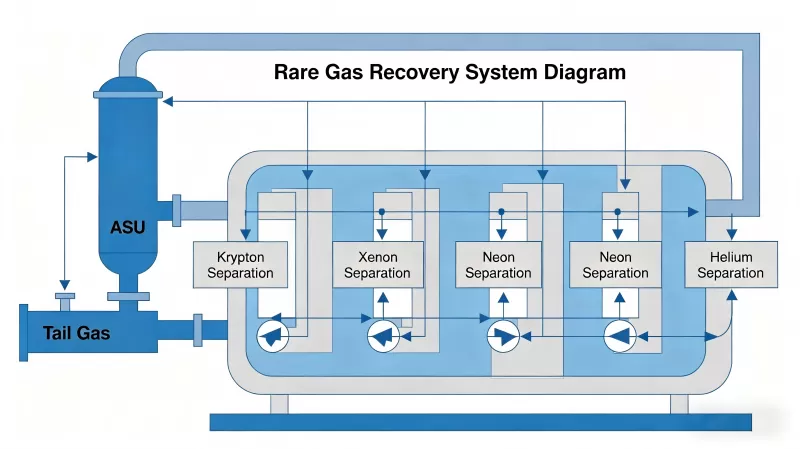
How Rare Gas Recovery Works — From ASU Tail Gas to High-Purity Product
The ASU Connection: Where Rare Gases “Hide”
Large-scale ASUs primarily produce oxygen and nitrogen. Rare gases do not disappear—they concentrate in specific side streams during cryogenic processing:
Krypton/Xenon tend to concentrate with oxygen-rich fractions (often linked to LOX handling routes)
Neon/Helium are typically found in non-condensable fractions associated with nitrogen stream handling and tail gas management
This is why the most cost-effective rare gas production often comes from recovery, not “primary” manufacturing.
Process Deep-Dive: Two Main Recovery Pathways
1) Krypton/Xenon Recovery (Often Associated with LOX-Related Streams)
A typical route includes:
Concentration of Kr/Xe-rich mixtures
Multi-step fractional separation
Purification to industrial or semiconductor specifications
This is the basis for solutions commonly described as xenon/krypton recovery from ASU tail gas (implementation varies by ASU configuration and operating objectives).
2) Neon/Helium Recovery (Non-Condensables from Nitrogen Handling)
Because helium and neon are extremely volatile, they are often recovered from:
Fortune Gas Rare Gas Recovery Systems: Designed for Yield, Purity, and Integration
A modern rare gases cryogenic system is not just a “bolt-on box.” It must be engineered around:
Existing ASU flows and cold box interfaces
Contaminant profiles (including moisture, hydrocarbons, and trace impurities)
Target product slates (Ne/He vs. Kr/Xe) and required purity
Fortune Gas focuses on cryogenic system solutions that aim to maximize:
Recovery rate (economics)
Product stability (quality)
Operational uptime (reliability)
Why Source Rare Gases from China? The Fortune Gas Advantage
In today’s volatile sourcing environment, buyers are actively diversifying supply chains. China has become a major player in rare gas separation and supply—especially when the procurement requirement includes technical coordination, consistent output, and scalable delivery.
Supply Security for Industrial and High-Tech Buyers
For procurement managers and engineers, stable availability is often as important as price. A qualified supplier must demonstrate:
Purity Standards: 5. and 6. Grades for High-End Applications
High-value applications frequently require:
Fortune Gas supports high-purity targets through controlled recovery, purification, and QA practices aligned to customer specifications.
Customization: From Xenon Gas Plants to Tailored Generators
ASU operators differ widely in scale and recovery goals. Fortune Gas can support engineered solutions such as:
xenon gas separation configurations matched to your ASU
high purity krypton xenon gas generators tailored to plant size (commonly aligned with ASU capacities in the ~20,000 to 100,000 Nm³/h class)
Industrial Applications: From Silicon Wafers to Deep Space
Semiconductors: Etching and Lithography
Rare gases enable critical steps including:
Aerospace: Xenon for Ion Propulsion
Xenon is widely used as a propellant for electric propulsion systems (including Hall-effect thrusters) because it’s inert, heavy (efficient momentum transfer), and stores well under pressure—making it ideal for long-duration missions.
Medical: Xenon and Helium in Advanced Healthcare
Depending on regional approvals and application design, rare gases are used across:
Future-Proofing with Advanced Recovery Units
The ROI of Recovery: Why Adding Recovery is Becoming a Necessity
For many ASU operators, installing a krypton xenon recovery unit or neon gas recovery capability is shifting from “nice-to-have” to economic strategy—because:
rare gas prices can be volatile
recovered byproducts can become significant revenue streams
improved utilization strengthens long-term competitiveness
Innovation: Energy-Aware Cryogenic Designs
Next-generation rare gases cryogenic systems focus heavily on:
optimized heat integration
stable operation across load swings
minimized energy penalty while maintaining purity
Partnering for Purity (and Long-Term Supply Confidence)
Rare gases may be present only in trace amounts, but they sit at the center of modern manufacturing and aerospace innovation. The winners in this market will be those who can secure both purity and supply reliability—through engineered recovery, disciplined QA, and scalable production planning.
If you’re evaluating a rare gas recovery system, considering a retrofit to an existing ASU, or sourcing high-purity krypton, neon, xenon, or helium, Fortune Gas can support technical consultation and supply proposals.
FAQ
What is the purity of Fortune Gas krypton and xenon?
Fortune Gas can supply krypton and xenon in high-purity grades such as 5. (99.999%) and, for select requirements, 6. (99.9999%), depending on product and application needs.
Can rare gas recovery systems be retrofitted to existing ASUs?
Yes. Many recovery solutions can be engineered as retrofits, but feasibility depends on the ASU configuration, available tie-in points, contaminant profile, operating mode, and target product slate (Ne/He vs. Kr/Xe).
Why is xenon used in satellite propulsion?
Xenon is inert and has a high atomic mass, making it efficient for electric propulsion (e.g., Hall-effect thrusters). It is also practical to store and handle for long-duration space missions.


