Neon is present in atmospheric air only in very small quantities, so commercial production is normally connected with large-scale air separation rather than a dedicated process that treats air solely for neon. During cryogenic air separation, neon does not disappear with the main oxygen and nitrogen products. Instead, it tends to become concentrated together with other highly volatile components in specific non-condensable streams.
This creates an opportunity for neon gas recovery. However, adding a recovery system is not simply a matter of collecting an ASU vent stream. Feed composition, ASU operating conditions, recovery target, helium content, contaminants, available refrigeration, product purity, and integration with the existing cold section all influence the final process configuration.
For industrial gas producers and ASU operators, a successful project therefore requires the neon recovery section to be designed as part of the wider air separation system rather than treated as an isolated auxiliary unit.
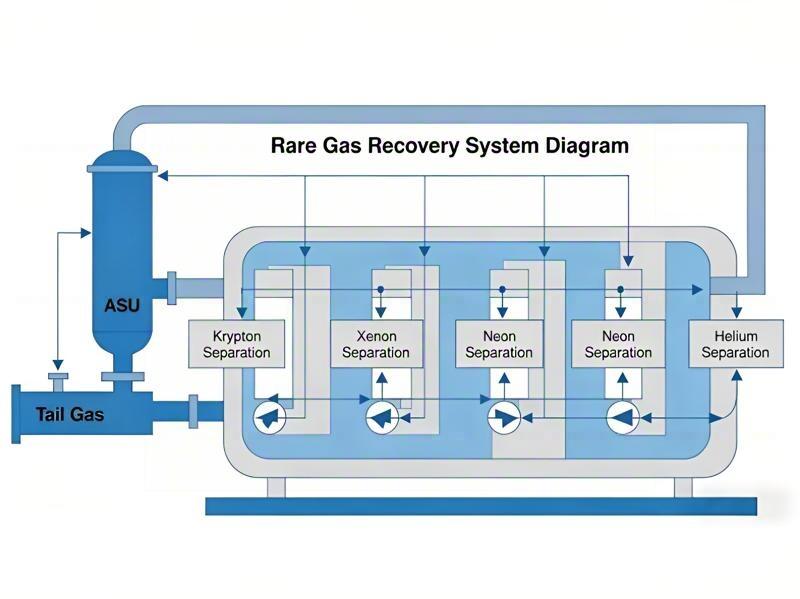
Where Neon Comes From in an Air Separation Unit
Neon entering an ASU originates from atmospheric air and tends to concentrate in light, non-condensable fractions during cryogenic separation.
A conventional cryogenic ASU is primarily designed to separate oxygen, nitrogen, and often argon. Atmospheric air is compressed, purified, cooled, and separated through cryogenic distillation according to the different volatility of its components. Neon and helium behave differently from the main air gases because they remain highly volatile under conditions where much of the nitrogen and oxygen is being condensed and separated.
As a result, certain nitrogen-side non-condensable, purge, or vent streams may become enriched in neon and helium compared with the original atmospheric feed. Instead of allowing these valuable components to leave with a waste or vent stream, a suitably designed recovery section can capture the enriched fraction for further concentration and purification.
The exact recovery point depends on the ASU configuration. Column arrangement, nitrogen condensation strategy, product specification, pressure level, refrigeration balance, and existing cold-box design can all determine where an appropriate neon-bearing stream is available.
This is an important distinction for project owners: there is no universal extraction point that can be applied to every ASU plant. The first step in a neon recovery study should therefore be a process review of the existing or proposed air separation system.
How Neon Gas Recovery Works in an ASU
Neon gas recovery typically involves capturing a neon- and helium-enriched non-condensable stream, reducing unwanted components, concentrating the valuable light gases, and then sending the crude mixture for further purification or separation.
The recovery process starts with identifying a suitable stream in which neon has already been enriched by the main air separation process. Nitrogen still represents an important component of many of these streams, so the recovery section must separate as much of the nitrogen and other unwanted material as practical while retaining neon and helium.
Depending on the process design, this can involve additional low-temperature separation, condensation, phase separation, adsorption, or other purification steps. The objective at this stage may not be to produce final high-purity neon immediately. In many projects, the ASU recovery section first produces a crude neon-helium concentrate that is then processed further.
The recovery system must also interact carefully with the original ASU. Removing too much nitrogen-side flow or changing refrigeration conditions can affect the performance of the main separation columns. Good engineering therefore aims to recover the valuable non-condensables while maintaining stable oxygen, nitrogen, and argon production.
For this reason, neon gas recovery should be evaluated through a complete material and energy balance rather than by considering the rare-gas stream alone.
Key Factors Affecting Neon Recovery Efficiency and Purity
Neon recovery performance is mainly determined by feed composition, recovery-point selection, operating stability, impurity control, process configuration, and the required final product specification.
The concentration of neon available to the recovery section has a direct effect on process economics. A poorly selected feed stream may require excessive downstream separation for a relatively small amount of recoverable product. In contrast, a properly selected enriched stream can reduce the separation duty required downstream.
Operating stability is equally important. Variations in ASU load, nitrogen production, column pressure, liquid inventory, or product demand can change the composition and flow of the neon-bearing stream. A recovery process designed only around one operating point may therefore struggle when the main ASU moves through normal load changes.
Impurities must also be considered carefully. Hydrogen, nitrogen, helium, and trace contaminants may accompany neon through different stages of recovery. Their treatment depends on the required product route and whether the system is producing crude neon concentrate or preparing feed for further high-purity purification.
| Design Factor | Why It Matters | Engineering Consideration |
|---|
| Feed Stream Composition | Determines the initial neon concentration and impurity load | Select the most suitable ASU recovery point |
| ASU Operating Load | Can change feed flow and composition | Design for normal operating range, not one fixed condition |
| Nitrogen Content | Increases downstream separation duty | Optimize condensation and concentration steps |
| Helium Content | Affects final neon purification strategy | Plan He-Ne separation according to product targets |
| Target Purity | Determines the required downstream purification depth | Define product specification before final process design |
| ASU Integration | Recovery can influence refrigeration and column balance | Evaluate the complete ASU material and energy balance |
Recovery rate and purity should therefore not be optimized independently. Maximizing extraction at any cost may increase energy use, complicate operation, or negatively affect the main ASU. The more practical goal is to achieve a stable balance between neon yield, product quality, ASU performance, and operating cost.
System Design Considerations for Neon and Helium Separation
Neon and helium frequently appear together in ASU non-condensable streams, making their downstream separation an important part of a complete neon production scheme.
Because both gases are highly volatile, recovering them from the main nitrogen stream does not automatically produce pure neon. The first recovery stage may instead create a neon-helium-rich mixture containing residual nitrogen and other light impurities.
The downstream process therefore depends heavily on the required product specification. If the commercial objective is a crude rare-gas concentrate for further processing elsewhere, the plant may not need the same purification depth as a facility intended to produce a tightly controlled final product.
Engineers should define the desired neon and helium product routes before selecting equipment. This includes expected feed composition, target recovery, purity requirements, available refrigeration, utility conditions, operating pressure, and whether purification will occur on site or at another facility.
Another important consideration is turndown. Rare-gas recovery is tied to the operation of the parent ASU, so the recovery section must remain controllable as air flow and product demand change. Instrumentation, process control, recycle strategy, and protection against off-specification feed are therefore as important as the separation equipment itself.
Companies evaluating rare-gas technologies alongside other cryogenic systems can review Fortune Gas's cryogenic technology and product portfolio when defining the broader project scope.
Integrating Neon Recovery into New and Existing ASU Plants
Neon recovery can be considered during the design of a new ASU or added to an existing plant, but retrofit projects usually require more detailed interface and operating-condition analysis.
For a new ASU, the rare-gas recovery requirement can be included from the beginning. Engineers can evaluate stream routing, cold-box interfaces, refrigeration demand, control philosophy, plot space, piping, and future purification requirements while developing the main air separation process. This generally gives the project more flexibility to optimize the ASU and neon recovery system together.
An existing ASU presents different challenges. The engineering team needs accurate process data, operating history, stream compositions, cold-box configuration, available tie-in points, utility capacity, and information about current operating constraints. A technically attractive recovery concept may still be impractical if the necessary stream is inaccessible or if modifications would create excessive shutdown requirements.
Project owners should therefore begin a retrofit study with actual plant data rather than assuming that every large ASU is automatically suitable for neon recovery. Process simulation and integration review can determine whether sufficient recoverable feed exists and how the new section could influence the existing oxygen, nitrogen, and argon system.
If you are evaluating neon recovery for a new ASU or considering an upgrade to an operating plant, you can contact the engineering team with the ASU capacity, current process configuration, available stream data, and required rare-gas product specifications for preliminary assessment.
Conclusion
Effective neon gas recovery begins with understanding how neon behaves inside the parent ASU. The recovery point, feed composition, nitrogen removal, helium separation, purity target, refrigeration balance, and interaction with the main air separation process all influence whether a project can operate efficiently and reliably.
New ASU projects provide the greatest opportunity to integrate rare-gas recovery into the original process design, while existing plants require a careful retrofit assessment based on actual operating data and available interfaces. In both cases, the objective should be a balanced system that recovers valuable neon without compromising the primary ASU products.
With experience in air separation, cryogenic process engineering, and rare-gas extraction systems, Fortune Gas can approach neon recovery as part of the complete ASU process rather than as a stand-alone add-on. This system-level perspective is particularly important when neon and helium recovery must be coordinated with existing plant capacity, purity requirements, and long-term operating objectives.
Frequently Asked Questions
1. Where is neon recovered from in an ASU?
Neon is generally recovered from enriched non-condensable streams associated with the cryogenic separation process. The exact recovery point depends on the ASU configuration and nitrogen-side process design.
2. Are neon and helium recovered together?
They are often present together in ASU non-condensable fractions. The initial recovery stage may therefore produce a neon-helium concentrate that requires further separation and purification.
3. Can neon recovery be added to an existing ASU?
Yes, in some cases. Feasibility depends on stream composition, available tie-in points, cold-box configuration, refrigeration balance, utility capacity, and the required product specification.
4. What information is needed for a neon recovery project?
Important data include ASU capacity, process configuration, stream composition and flow, operating pressures, load range, current product specifications, available utilities, and target neon and helium purity.

